
Greer County Crime News Sources
For anyone in custody right now, the GCSO inmate search comes first. It is an official tool. You can search by name and see booking dates, charges, and more. The sheriff's home page also runs a strip of recent bookings. Neither one works as a full historical arrest database, and the roster entry shown listed no image.
Need an actual booking sheet or a retained photograph? The sheriff's records division handles those requests, along with jail-register questions. Once a case moves into court, the Greer County Court Clerk and OSCN hold the later records. Those offices answer questions a news story never will.
Greer News Outlets and Coverage
Greer County has a compact news scene. The Mangum Star-News is the most reliable source for recurring arrest-log material. KSWO 7News and KECO 96.5 FM also run crime and court stories from the area. None serves as an official booking-photo feed, though. Use them for context. Then go to GCSO for custody facts.
| Source | Observed coverage | Photo or record limit |
|---|---|---|
| GCSO | Official current custody, records, booking strip, and agency updates. | Roster result reviewed with no displayed image. |
| Mangum Star-News | Weekly issue pages with recurring arrest and police-log material. | No established recurring photo policy; not live custody. |
| KSWO 7News | Selected Mangum and countywide reports. | A story image may be attributed to the jail, not a general publication policy. |
| KECO 96.5 FM | Selected Greer, Granite, and Mangum-related reporting. | No recurring booking-photo or daily feed found. |
Two Mangum Star-News issue pages carry arrest-log material. One is dated August 7, 2026. The other is May 22, 2026. These are weekly issue-based reports, so one issue can cover events from several days. Entries typically list names, locations, and charge or hold descriptions. Keep in mind that the text does not confirm every item ended in a county booking.
Mangum Weekly Arrest Log Pattern
The Mangum Star-News August 7 issue page shows how this works. Arrest and police logs sit inside the weekly issue. There is no separate live mugshot page. Coverage leans toward Mangum and the county seat. Wider county activity shows up too. A log helps most when you need a date, a spelling, or an agency name before an official follow-up.
Weekly reporting runs on its own clock. Someone named in a log may already be out of custody. Another person might get booked and released before the issue even prints. So a log is a cross-check, never a complete list of county arrests. Confirm anything you find through GCSO and the court docket.
The issue page appears below as published context. It is reporting, not an official county record.
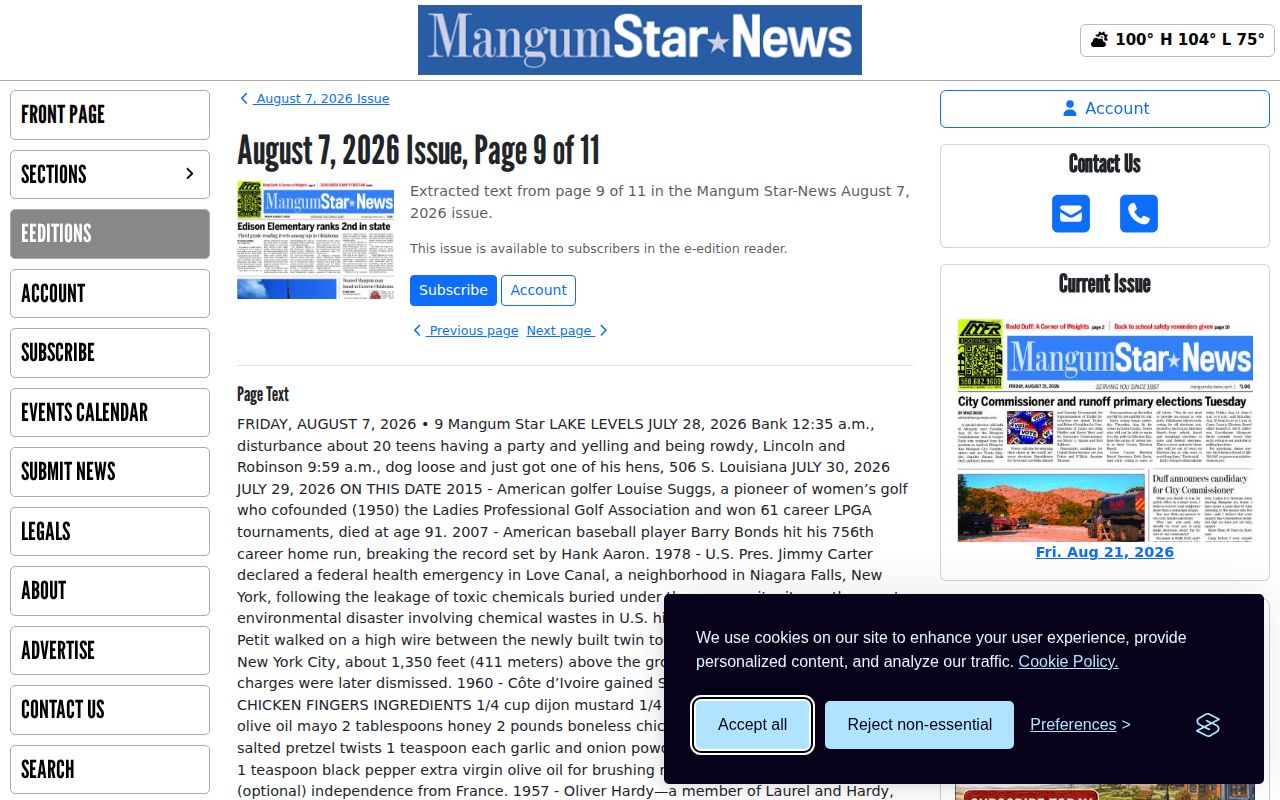
Verify dates and wording in any weekly report against the agency record and the court docket, since each source exists for a different purpose.
How Greer Booking Photos Reach News
Oklahoma's Open Records Act is where public access to photographs and law-enforcement material begins. Exceptions and redactions still apply. The law does not force agencies to post every image online. GCSO's public roster showed no image available. The sheriff runs no booking-photo gallery for the county.
One KSWO story from 2021 carried an image credited to the Greer County Jail. That is a single documented sourcing path for one story. It does not mean the jail hands out photos in every case. Reporters might use agency material, a records request, a supplied image, or nothing at all. The agency decides how to handle each request.
Put official sources first. Secondary publishers can lag, pick selectively, or simply get things wrong. A photo attached to a story is just a record of a reported arrest event.
From Greer News to the Record
Treat a news report as a lead, not a finish line. Check the name, date, place, and agency in the story against the official sources. That habit prevents a common mistake. People often assume someone is still locked up because an old story stays online after a release or transfer.
- Save the story date, name spelling, and agency reference.
- Check the GCSO roster and booking routes for current county custody or a recent booking lead.
- If no current result appears, ask GCSO records for the specific booking or incident record.
- Search OSCN or contact the county clerk for a filed case, hearing, dismissal, judgment, or sentence.
- Read each result in its custody stage and access date, not as a permanent account.
Greer Secondary News and Indexes
Two Greer-specific secondary indexes exist. RecentlyBooked has a county section, and Mugshots.com links to Greer County through its Oklahoma index. Both are unofficial. Their material can lag or fall short, and neither replaces the sheriff, the records division, or the court. One Mugshots.com example was dated and carried no image. RecentlyBooked sometimes shows extra fields or a photo, but those display choices do not reflect any official GCSO format.
The gaps matter elsewhere too. Arrests.org has a statewide Oklahoma interface but no confirmed Greer-local section, and Busted Newspaper and Mugshots.zone likewise have no verified Greer pages. A statewide result or a neighboring county's listing should never pass for Greer coverage. Treat a city label on a secondary site as nothing more than a lead worth checking against the real record.
Greer City Reporting Limits
Mangum gets the most consistent local coverage, largely because the Star-News calls it home. KSWO picks up selected Mangum and county stories too, though some of its police-force pieces are historical and shouldn't be read as current staffing news. KECO chimes in on Mangum and Granite cases when something big happens. Willow is the quiet one. No outlet offers a routine arrest log or a photo feed devoted to that city.
Each city takes its own route. Mangum Busted Mugshots starts with a police contact page plus GCSO custody information, while Granite demands sorting out conflicting municipal contacts first. Willow defaults to GCSO since no independent police portal checks out. City news adds color and context, but the booking and court trail still runs through the county. Check a report's publication date before leaning on it for a records request, then confirm the details with GCSO yourself.
Greer Reporting Versus Official Records
News stories and official records do different jobs. A reporter might build one from an interview, a court filing, a supplied photo, or several sources at once. That speed is useful. The tradeoff is selectivity: the story may skip a booking number, the exact time of intake, or the outcome the court later reached. Those specifics live in the record itself, not the article.
The GCSO system has its own gaps. Its roster shows current custody, the home page rolls recent bookings past, and neither page promises a full archive. Someone can drop off the roster after release while the article stays online forever. Flip it around, and a person can sit on the roster with no news story at all. Each source only tells the part it actually keeps.
A photo in a report stays in that context. It grants no right to copy, gather, or reuse booking images. Want to know whether a specific photo exists and can be released? Ask the GCSO records division. The Open Records Act lets an agency apply exemptions and redact what's needed, and it never forces an agency to build a record it doesn't already hold.
Local journalism still earns its place when handled with care. A weekly log can pin down a date range that sharpens a request. A broadcast piece may name the arresting agency. A radio story might surface a court connection. From there the path repeats: GCSO for county custody or booking records, the city agency for a municipal incident, OSCN or the clerk for how the case ended. That sequence keeps a custody event, a charge, and a verdict in their proper lanes.